
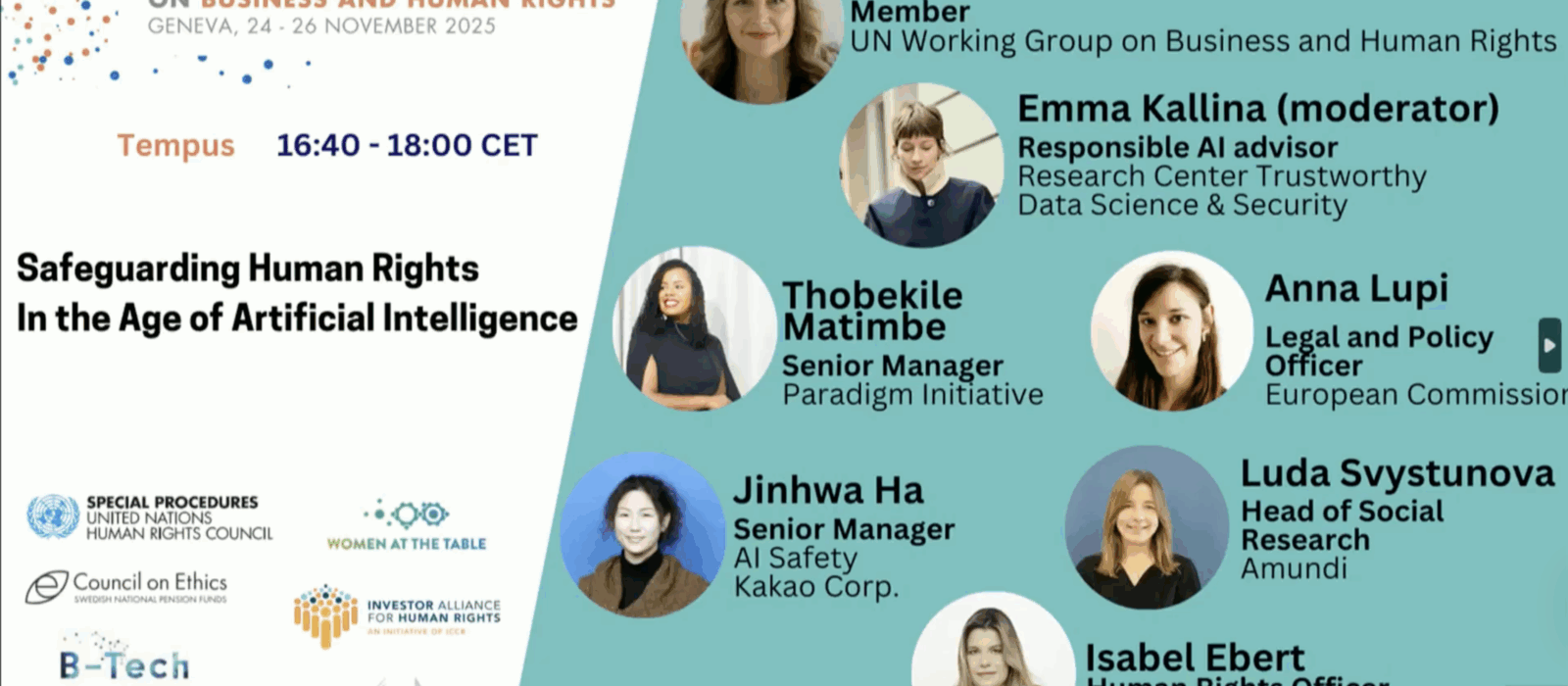

Safeguarding Human Rights in the Age of Artificial Intelligence UN Business & Human Rights Forum
Session co-organized by the Working Group on Business and Human Rights, European Commission, OHCHR B-tech Project, AI & Equality (by Women @ the Table), Investor Alliance for Human Rights, Council on Ethics for the Swedish National Pension Funds, and World Benchmarking Alliance.
Interpretation in English, French and Spanish
Brief description of the session:
As artificial intelligence (AI) becomes increasingly embedded in public and private sector decision-making, its development, procurement and deployment during times of crisis and transformation raises urgent human rights concerns. From biased algorithms in hiring and surveillance to opaque decision-making in public services, the impacts can be particularly acute for at-risk communities. These technologies often reflect and reinforce existing inequalities, especially when developed without adequate understanding of the social, cultural, and political contexts in which they are deployed.
Businesses developing, procuring or deploying AI have a responsibility to respect human rights, as outlined by the UN Guiding Principles on Business and Human Rights (UNGPs), including by implementing human rights due diligence which, in the AI context, must be early, ongoing, and context-specific. It must also involve meaningful stakeholder engagement, particularly at-risk communities. States also have a duty to protect individuals from AI-related harms, requiring a “smart mix” of regulatory and policy measures to align corporate conduct with human rights. This includes embedding human rights due diligence into AI regulation, ensuring coherence across national and global levels, and anchoring regulatory approaches in human rights—not just safety or security. These measures should apply across sectors and emphasize transparency, accountability, and data protection throughout the AI lifecycle.
In the public sector, procurement processes are a critical yet underutilized safeguard to ensure AI systems respect human rights. Meanwhile, in the private sector, investor and civil society pressure is mounting to hold businesses accountable for digital rights harms. Gendered impacts of AI, including online violence, surveillance, and algorithmic bias, further underscore the need for intersectional approaches. This session will explore how development, procurement, regulation, and stakeholder engagement can be leveraged to identify, prevent and mitigate adverse human rights impacts of AI systems.
- Examine how public procurement processes can serve as a frontline defense for human rights in AI deployment.
- Explore the intersection of AI, gender, and digital rights, and how the UNGPs can guide rights-respecting innovation.
- Highlight the role of investors and civil society in driving corporate respect for human rights and holding companies accountable for AI-related harms.
- Identify practical tools, frameworks, and data sources that support rights-based AI governance.
- How can procurement frameworks be designed to anticipate and mitigate adverse human rights impacts in public services, particularly amidst crises and transformation?



Isabel Ebert
Adviser/Human Rights Officer, OHCHR B-Tech

Thobekile Matimbe
Senior Manager Partnerships and Engagements, Paradigm Initiative, Paradigm Initiative


– Senior Manager, Al Safety Team (Feb ’25~Current)
– Project Leader, Group Tech Ethics Team, Corporate Alignment Center (Mar ’24~Feb ’25)
– Senior Manager, Human Rights and Tech Ethics Team (Nov ’22~Mar ’24)

Legal and Policy Officer in the Responsible Business Conduct, European Commission, Directorate General Growth