Building Fairer AI: New UN Guidance for Equitable Artificial Intelligence Standards
Digital technologies are evolving at breakneck speed, with artificial intelligence becoming more powerful each day. However, the benefits of AI are not distributed equally—algorithms trained on biased data often perpetuate and amplify existing inequalities, particularly affecting women and marginalized communities.

Why This Matters
AI systems now influence critical decisions across healthcare, finance, hiring, and public services. Yet these systems frequently inherit historical biases: medical AI trained primarily on male patient data may miss critical conditions in women, hiring algorithms penalize career gaps associated with caregiving, and facial recognition systems disproportionately misidentify women and minorities.
The problem stems from three types of bias: preexisting bias rooted in societal inequalities, technical bias from design choices that encode assumptions, and emergent bias that develops through real-world use and feedback loops.
Our Comprehensive Consultation Process
Recognizing the urgency of this challenge, the UN Economic Commission for Europe’s Team of Specialists on Gender-Responsive Standards (ToS-GRS) undertook extensive consultations to develop practical guidance. We engaged with:
- Technical experts from international standards bodies including ISO, IEC, and IEEE
- Civil society organizations advocating for digital rights and gender equality
- Industry stakeholders from AI development companies and deploying organizations
- Policymakers working on AI regulation and governance frameworks
- Affected communities, particularly women’s groups and marginalized populations who experience AI bias firsthand
This multi-stakeholder approach ensured our recommendations address both technical feasibility and real-world impact.
Key Recommendations
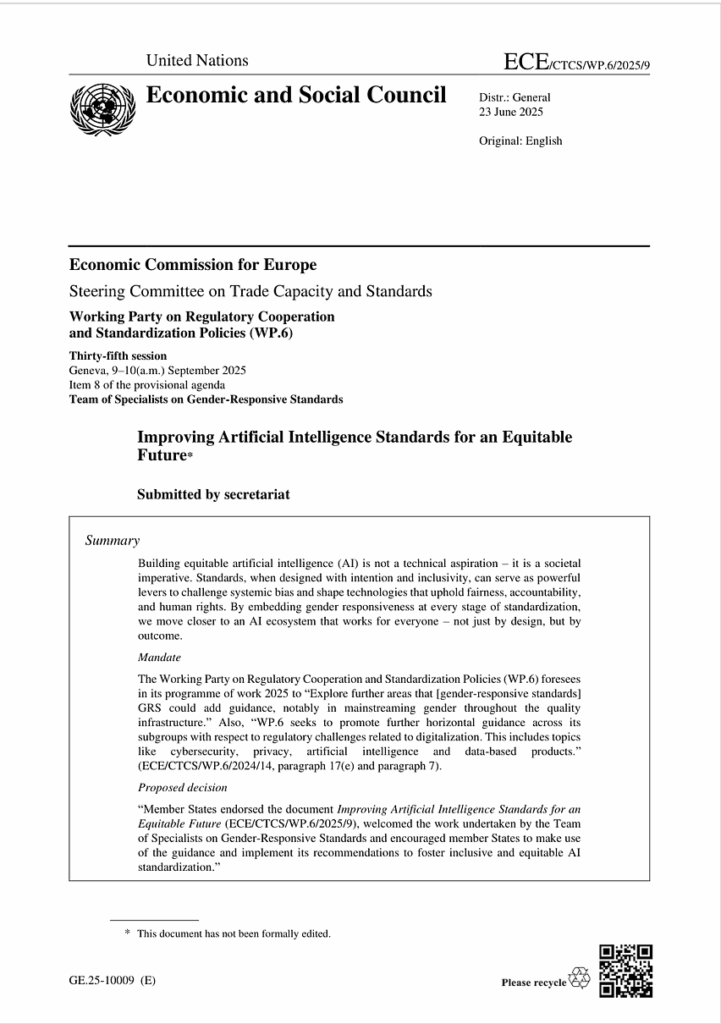
Our guidance document, “Improving Artificial Intelligence Standards for an Equitable Future” (ECE/CTCS/WP.6/2025/9), provides actionable recommendations for member states and software developers:
Strengthen Oversight: Establish mandatory third-party audits throughout AI lifecycles, with post-market monitoring to catch and correct biases in real-time.
Embed Gender-Responsive Practices: Require disaggregated data collection, evaluate systems for fairness alongside accuracy, and challenge assumptions of algorithmic neutrality.
Ensure Inclusive Development: Involve diverse stakeholders—especially affected communities—throughout standards development, not just during final review stages.
Harmonize Globally: Align with international frameworks like the OECD AI Principles and UNESCO’s AI Ethics Recommendation to create consistent, cross-border approaches.
Institutionalize Change: Build gender-responsive capacity within standards bodies and regulatory agencies for sustained institutional transformation.
The Path Forward
Building equitable AI isn’t just a technical challenge—it’s a societal imperative. Standards can serve as powerful levers to challenge systemic bias when designed with intention and inclusivity. By embedding gender responsiveness throughout standardization processes, we can create an AI ecosystem that works for everyone.
We encourage member states to implement these recommendations and call on software developers to integrate these principles into their development practices. The future of AI should be one where technology serves all people equitably, upholding human rights and promoting inclusive innovation.
The full guidance document is available for download and provides detailed implementation strategies for policymakers, regulators, and industry stakeholders committed to building fairer AI systems.