The AI & Equality Toolboxes put human rights in the hands of the people who actually design and deploy AI, turning a body of law and theory into questions a development team can answer on a Tuesday morning. One foundational methodology, distilled into a working tool, and remade for the contexts that need it most.
The foundation: a methodology for the whole AI lifecycle
It begins with a white paper, Integrating Human Rights Considerations Along the AI Lifecycle, developed in collaboration with the UN Office of the High Commissioner for Human Rights. Rather than treat rights as a compliance box to tick at the end, it sets out reflection questions for each of the six stages of AI development, so human rights are weighed as they become relevant rather than as an afterthought. Its aim is not only to avoid harm but to build AI that actively promotes human dignity and community empowerment. Available in English and French.
From principle to practice: incorporating HUDERIA
A methodology is only as strong as its use, and ours became fully operational when it met HUDERIA, the Council of Europe’s Human Rights, Democracy, and the Rule of Law Impact Assessment, developed by the Alan Turing Institute and adopted by the Council in November 2024. The Turing approached us: they recognised our approach as one of the few that was genuinely actionable, and asked how the two could be combined. The result is an accessible assessment any team can run, that routes the highest-risk systems to HUDERIA’s deeper process.
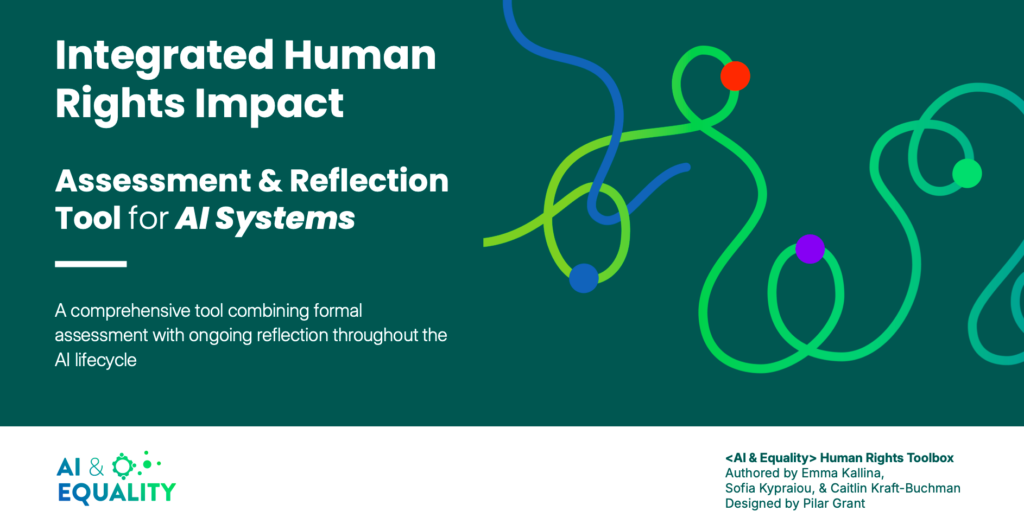
The Human Rights Impact Assessment Workbook
That practice lives in the Human Rights Impact Assessment Workbook, a single working tool that distils the methodology into something any team can use, with or without legal training. It pairs open reflection questions for team discussion with formal assessment sections for documentation, across all six lifecycle stages, from setting the objective and composing the team through data, model development, testing, and post-deployment monitoring. It can be worked through progressively, at project milestones, or as a one-off audit; it maps to obligations such as the EU AI Act; and it flags where a high-risk system needs HUDERIA’s deeper assessment. It is free to download, and built to be used rather than shelved.
Built for context: the regional toolboxes
A methodology written in Geneva should not be dropped unchanged onto every context. So the toolbox has been rebuilt, with local partners, for the places using it.
African AI & Equality Toolbox
The African AI & Equality Toolbox, developed with the African Centre for Technology Studies (ACTS), is African-led and African-authored, with its own case studies and solutions across five strategic sectors, from agriculture and health to climate, language, and digital safety.
The Latin American Toolbox, developed through 2025 with Chile’s National Centre for Artificial Intelligence (CENIA), brings its own perspective, solutions, and stories. Rebuilt for the University of Chile’s UAbierta open-learning platform, it is the first course of its kind in Latin America, free and online, and thousands have already taken it.